


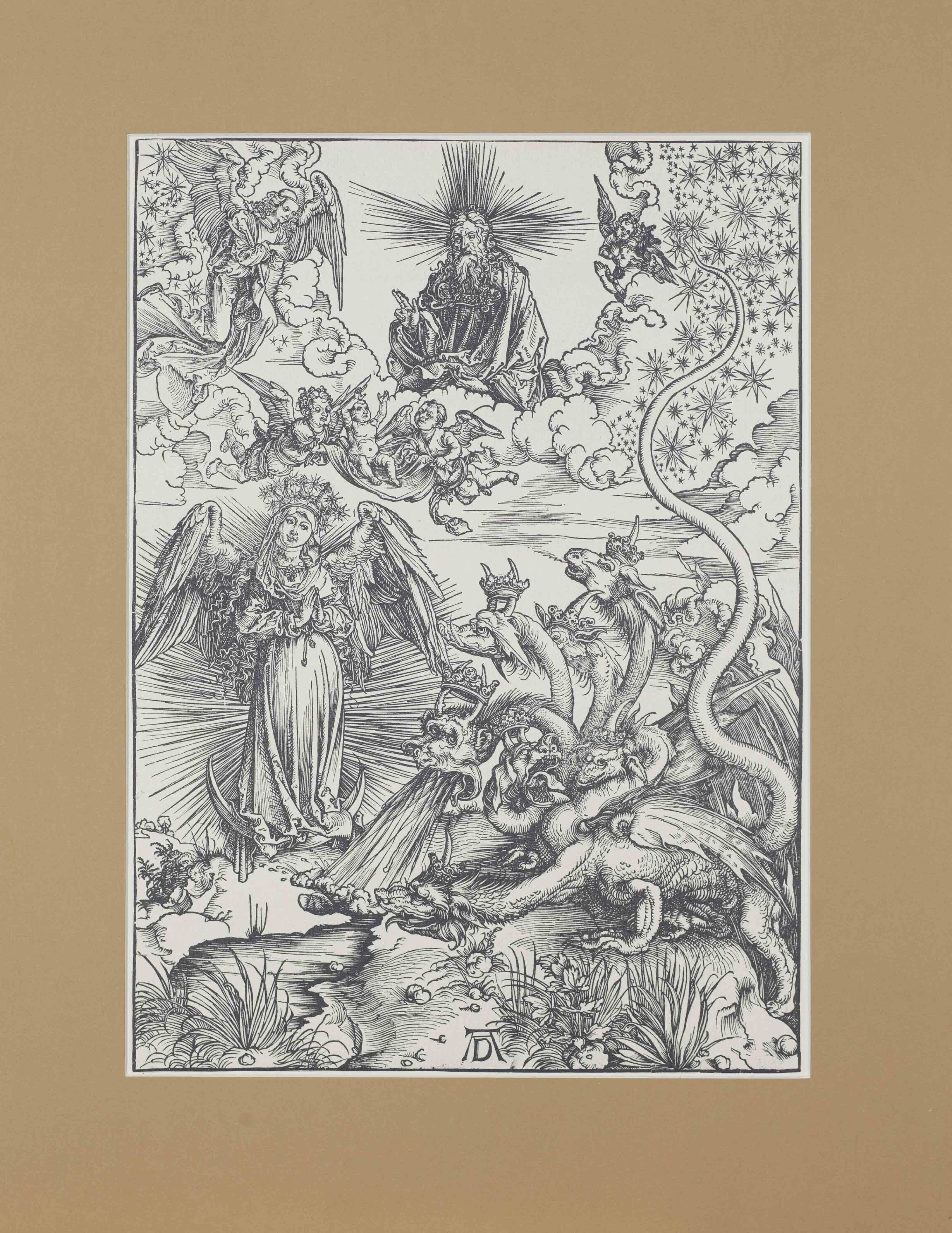
woodcut, paper, 40 x 30 cm (in light passe - partout),
Signed on panel, middleground: bound monogram "AD". 20th century print.
Albrecht Dürer's woodcut "The Woman and the Seven-headed Dragon" ("Die Frau und der siebenköpfige Drache") comes from his famous cycle "Apocalypse", which was published in 1498. The cycle is based on visions from the Apocalypse of St. John (the Book of Revelation), one of the most symbolic books of the New Testament, which describes the end of the world, the struggle between good and evil, and God's final victory over the forces of darkness.
The woodcut "The Woman and the Seven-Headed Dragon" illustrates a passage from Revelation, which describes the battle between the woman in heaven and the seven-headed dragon, or Satan incarnate. The woman is depicted in the central part of the painting, wearing a radiant robe, which alludes to the biblical description of the woman "clothed with the sun, and the moon under her feet, and on her head a crown of twelve stars" (Rev. 12:1). She symbolizes the Church, purity and holiness, as well as the Mother of God. Her silhouette exudes majesty and serenity, despite the dramatic situation. To the right of the woodcut can be seen the powerful figure of a dragon with seven heads and ten horns, which symbolizes Satan and his forces of evil. A woman gives birth to a child, who ascends to heaven. This is a symbol of Christ, who is to rule "all nations with a rod of iron" (Rev. 12:5). It is a motif of salvation and God's triumph over evil. In the background, above the scene, one can see figures of angels with swords, who are fighting against the forces of the dragon. This is a reference to the battle of Archangel Michael and his angels against demons, symbolizing the eternal battle between the forces of good and evil.
Dürer used the woodcut technique to achieve detailed and dramatic visual effects. The lines are precise, and the details - especially in the depiction of the dragon, the figure of the woman and the background - are rich and dynamic. The entire scene is filled with biblical and moral symbolism, which is typical of late medieval and early Renaissance art. Dürer created an apocalyptic vision, in which themes of hope, salvation and the inevitable struggle between good and evil are interwoven.
The "Apocalypse" series was Dürer's first major project, which brought him international fame. It was created during a period of great social, religious and political tensions in late 15th century Europe. At the time, people were living in an atmosphere of anticipation of the imminent end of the world, which explains the popularity of apocalyptic motifs in the art of the period. Dürer's woodcuts also show the influence of humanism and modern ideas. Although grounded in the medieval tradition, Dürer brought an innovative approach to composition and expression to his works, making his art unique to the period.










最後に閲覧したロット
出品リストを見るにはログインする必要があります
お気に入り
出品リストを見るにはログインする必要があります