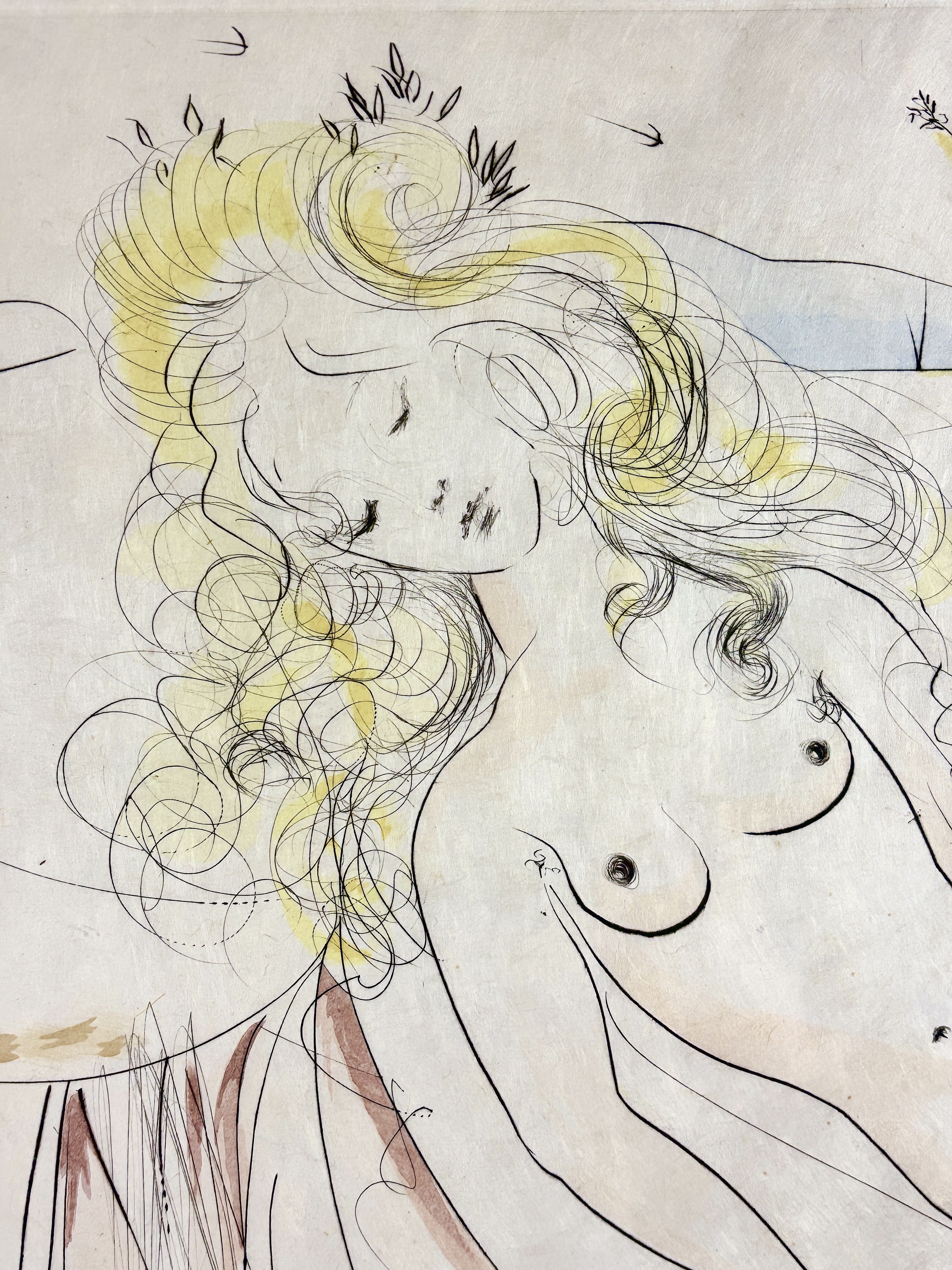
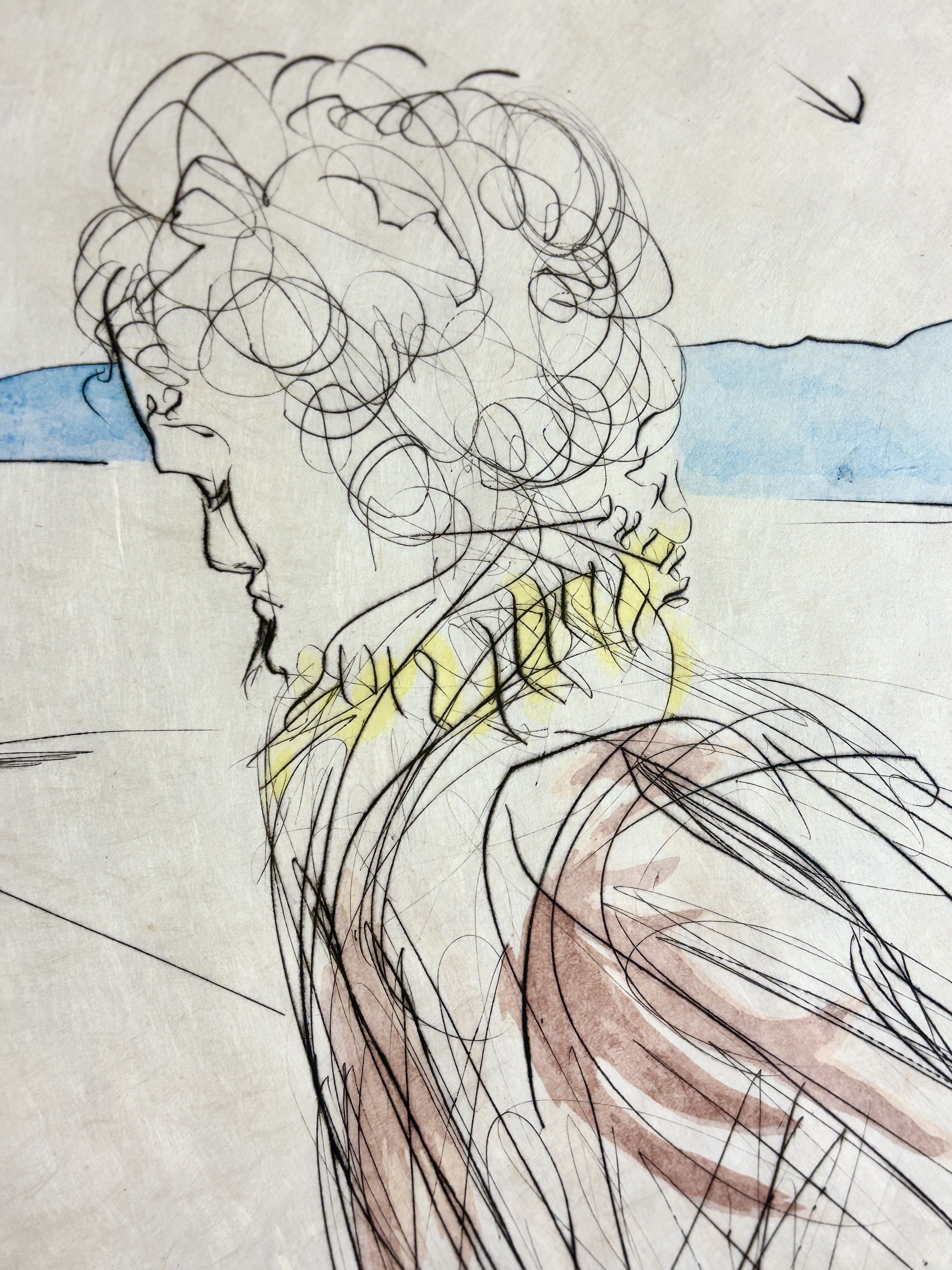
Drypoint etching with hand-painting (coloring) (stencil/gouache) on Japanese paper (Japon nacré) (this is a very fine, durable paper with a slightly pearlescent sheen and visible fibers, used for the most exclusive editions of art prints)
40 x 58 cm print, mounted in a 60 x 80 cm frame;
The edition printed on Japanese paper had a strictly limited run of 120 pieces (piece No. 60/120);
Hand-signed in pencil by Salvador Dalí at the bottom right;
Published by Vision Nouvelle in Paris (1971), printed at the renowned Parisian studio Atelier Rigal.
The work is from Salvador Dalí’s important print portfolio titled “Hommage à Albrecht Dürer” (also known as *Suite mythologique nouvelle* / *New Mythological Suite*), created in 1971. It is a surrealist reinterpretation of Titian’s classical masterpiece “Venus and the Organist.” Dalí transposes the Renaissance motif of eroticism and music into his characteristic, dreamlike world: On the left rests a nude, sensual Venus rendered in the undulating lines typical of Dalí’s mature drawing style. On the right is a figure in Renaissance attire (the organist / Mars) gazing at the goddess. In the background stretches a desert-like, surreal landscape with perspective lines, distant mountains, and a fountain—a motif characteristic of the artist.
The year 1971, when this portfolio was created, marked the official celebration of the 500th anniversary of Albrecht Dürer’s (1471–1528) birth, which is why Salvador Dalí dedicated his works to him. Dürer is considered one of the greatest copperplate engravers and printmakers in the history of art. Salvador Dalí greatly admired him for his brilliant drawing skills, precision of detail, and mastery of printmaking techniques (etching and copperplate engraving). Dalí, as an artist who valued traditional craftsmanship, sought to demonstrate his own technical virtuosity in this series and to measure himself against the legend of the Renaissance master.