


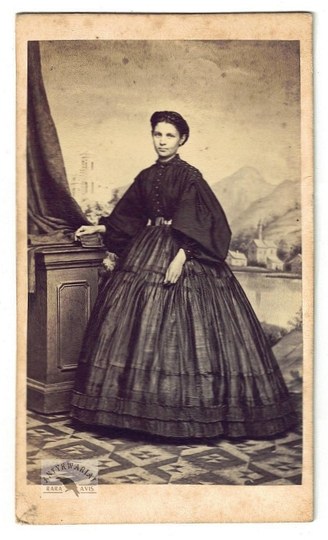
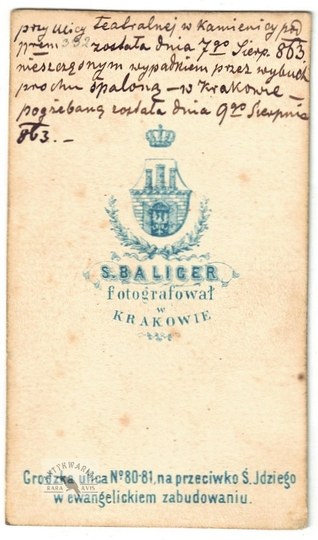
[JanuaryUprising– Marianna Wiatrowiczówna – portrait photograph – carte de visite format]. [before August 7, 1863]. Photograph measuring 9.1 x 5.6 cm on an original mount measuring 10.5 x 6.1 cm, taken atS[zymon] Balicer’s studioin Kraków.
The subject is depicted full-length, standing on a floor with a geometric pattern against a background of painted decoration, resting her right hand on a pedestal above which a suspended curtain is draped. She is dressed in attire from the “period of national mourning”—a full-skirted crinoline made of dark fabric. The photograph is mounted on an original cardboard backing. On the reverse is an advertising vignette for the studio with the following printed text: “S. Balicer photographed in Kraków,” “Grodzka Street No. 80–81, across from St. John’s in the Evangelical building,” and a handwritten ink inscription:“On Teatralna Street, in the tenement house at No. 392, on August 7, 863, she was tragically killed in a gunpowder explosion—in Kraków—and was buried on August 9, 863.” Local staining; overall condition is good.
"In 1863, Kraków, located within the Austrian monarchy, a dozen or so kilometers south of the borders of the Russian partition, became an important base and supply hub for the January Uprising. As Dr. Piotr Hapanowicz of the Museum of Kraków recalls, expeditions of volunteers set out from here to join the uprising. “This is where the wounded and fugitives from the Congress Kingdom were taken in. Shipments of weapons purchased in Vienna were sent from Kraków to the uprising, and ammunition factories and depots—located in many private homes—operated here. Sometimes, as a result, tragedies occurred in the city, claiming civilian lives,” Piotr Hapanowicz recalls in an interview with us. One such tragedy occurred on August 7, 1863. A secret gunpowder factory, located in Anna Krones’s tenement house at the corner of 223 Szewska Street (now No. 11) and Teatralna Street (now Jagiellońska). Five people were killed, including a 2-year-old girl named Ludka (Ludwika) Królikowska—the daughter of a well-known acting couple: Amelia (née Krajewska) and Karol Królikowski. Also killed were Barbara and Julia Janowska, aged 22 and 20, sisters of a Kraków actor; Marianna Wiatrowiczówna, aged 18, the daughter of a jeweler; and 15-year-old Ludwik Zborowski, a jeweler’s assistant. Several people were injured or burned, including Ludka’s grandmother, Joanna Krajewska. The Kraków daily *Czas* reported on the tragedy as follows: “A terrible tragedy occurred today in our city. At 4:45 in the afternoon, a terrible bang was heard, and billows of smoke rose into the air. It was an explosion of gunpowder on Teatralna Street […]. A certain amount of gunpowder was reportedly stored on the second floor of that house and caught fire under unknown circumstances.” The residents selflessly joined the effort to extinguish the fire. As Dr. Piotr Hapanowicz recalls, the funeral for the victims of the explosion took place on August 9, 1863. “It became a demonstration of the patriotic sentiments of Kraków’s society at the time,” Hapanowicz states.” (based on an article by Bartosz Dybała published on January 25, 2023, in *Gazeta Krakowska*—https://gazetakrakowska.pl/ from-the-history-of-krakow-a-2-year-old-girl-was-laid-to-rest-by-an-incalculable-procession-of-people-she-died-in-an-explosion-at-the-gunpowder-factory-krakow-residents-remember-her/ar/c1-17231373
S. Balicer (d. 1895)—a portrait photographer whose studio was located at 79 Grodzka Street, 80–81, and at 16 Wesoła and Kolejowa Streets (next to the military casino) from 1890 to 1904. The studio operated from 1849 until around 1905, though after the owner’s death in 1895, the business was run by a relative with the same first and last name. It began by using the reverse designs of Brunck F. Sohne of Nuremberg and Huth Gebruder of Dresden, and later remained loyal to Viennese firms: K. Krziwanek, Kühle & Miksche, E. Türkel, L. Türkel, and B. Wachtl.











最後に閲覧したロット
出品リストを見るにはログインする必要があります
お気に入り
出品リストを見るにはログインする必要があります