


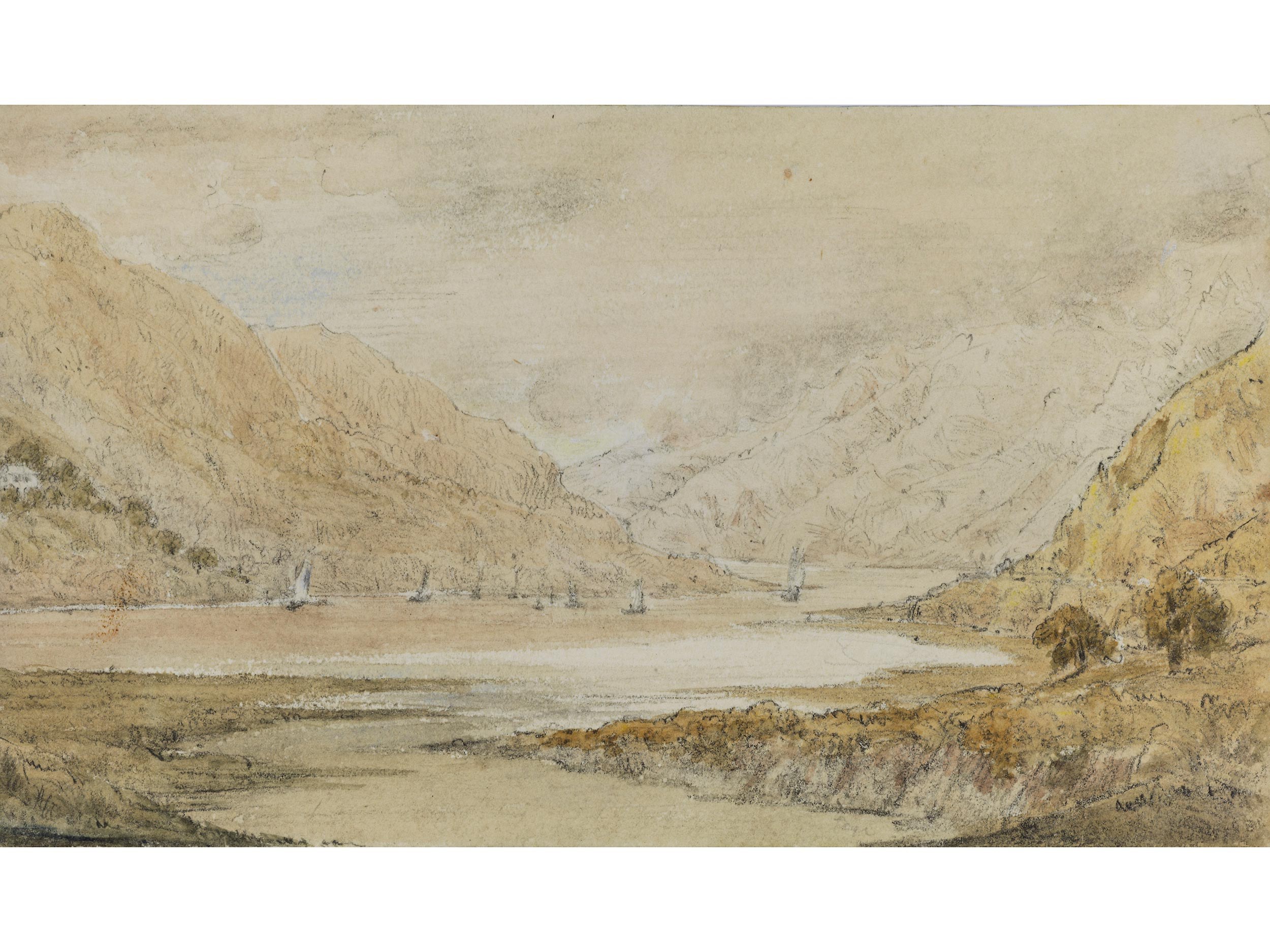
LOCH LONG SEEN FROM ARROCHAR
Graphite drawing watercolor on paper.
Sheet dimensions: 10.5 x 17.9 cm.
A trome l'oeil title "J.M.W. Turner, 1775 - 1851" on the lower part; truncated watermark "JWHATMAN 18...". Verso with monogram "J.M.W.T." as well as Anochar Head of Loch Long and third-party inscription.
On card inscribed in old ink, framed behind glass.
Viewed from a slightly elevated vantage point, the shore of Loch Long with its modest but efficiently rendered vegetation, the water rippling in the sunlight breaking on the shore and the sailing ships looming in front of the adjacent mountain ranges, which blur with the sunlight and vary from reddish brown to light yellow, while a mauve to violet zone of sky looms above the mountain range on the left, which appears to be reflected in the shore area.
Turner seems to have traveled to this area several times: Several of Turner's watercolor drawings depicting Scottish lochs are kept in London's Tate Gallery:
(a) a drawing from 1801 shows an inlet, presumably of Loch Lomond near Inveruglas, in a similarly fine, graphic style. Here, too, it is accentuated by subtle white heightening. Further examples from the 1801 sketchbook provide motif comparisons.
b) A sketchbook, for example with a drawing in Tate Britain from 1831, entitled Ben Arthur from Arrochar, may also be considered as evidence. Other drawings from 1831, such as "Arrochar Alps Across Loch Lomond", document his activities in this area.
c) A sketchbook by Turner from 1834 in the Tate Gallery with numerous depictions of Loch Ard.
Note:
Located in the Scottish Highlands, Loch Long stretches over 30 kilometers. As early as the 13th century, Vikings sailed along the loch and set their sights on Arrochar, an ancient Celtic settlement, but were defeated in the Battle of Largs in 1263.
J. Whatman's paper was regularly used by J.M.W. Turner for his intricate techniques, as the paper had special properties. Whatman's wove paper was stronger than laid paper because it was soaked in a gelatine bath made from boiled hooves and bones, making it extremely strong and less absorbent: several layers of paint could be applied, wiped, scratched or scraped off. In addition to Turner, John Robert Cozens, John Sell Cotman and Cornelius Varley also used this paper. (14100712) (13)








最後に閲覧したロット
出品リストを見るにはログインする必要があります
お気に入り
出品リストを見るにはログインする必要があります